Tirupati is a town in the south Indian state of Andhra Pradesh. Here, atop one of the seven hills is the very famous temple dedicated to Lord Sri Venkateswara, an incarnation of Lord Vishnu, one of the main deities of Hinduism.
The belief in the power of the deity is so widespread that anywhere between 50,000 to 100,000 people queue up every day -- for as many as two to four, or sometimes even five hours -- to offer their prayers, making it probably among the most-visited holy places in the world.
The picturesque town is known not just for the temple but also for the rich flora and fauna -- Sri Venkateswara National Park, spread over 353 square kilometres, housing about 1,500 plant species of 174 families; and Sri Venkateswara Zoological Park, spread over 22 square kilometres, having a wide variety of animals.
October 27
I, along with my wife and her sister's family of four, reached Tirupati in the afternoon. While my wife, her niece and I came from Bengaluru by bus, her sister, brother-in-law and nephew came from Bhopal by train.
We checked into one of the budget hotels, Shri Sai Tirumala Residency, near the Nandi Circle, which is not too far from either the bus stand or the railway station. We had lunch at the Orion Restaurant, a very nice place to dine -- a good variety of south and north Indian dishes, good ambience, and fairly priced. We had thali.
Thali means a plate, and in this context, comprising several vegetable dishes along with rice, chapatis (pancakes made of wheat) and a sweet -- considered a wholesome meal.
 |
| Kapileswara Swamy temple |
In the evening, my wife, her sister and I went to Kapileswara Swamy temple, very close to the Nandi Circle. It's one of the popular temples in the town. It is also known as Kapila Theertham temple. Theertham means holy water. There is a waterfall that springs from one of the cliffs at the foot of the Tirumala Hills. The water is considered holy and people stand under the waterfall and have a shower. There is a pond as well in front of it, in which many people take a dip.
We had light dinner, a couple of chapatis and curry, at a small nearby restaurant.
October 28
 |
| 800 steps done, 2,750 to go |
Either one can drive along the winding road up the hills (it's about 20 km) or walk up 3,550 steps over around 9 km. My wife, niece, nephew, and I chose the latter; while my sister-in-law and her husband decided to come by road. There are frequent buses in addition to jeeps that ply up and down the hills.
This is the third time my wife and I are climbing up the hills, while it's the first time for my niece who is 23 years old and her brother who is 16 years.
 |
| 950 more to go. |
We started the climb at 7.35 am. The footpath is concrete paved and is covered overhead. Roughly, the initial and the final 500 steps are a bit steep. The rest are gradual. There are plenty of small eateries that serve snacks and drinks on the way. There is also a medical dispensary, where the service is free, just in case one feels too uneasy and needs medical advice.
The climb does test one's physical as well as mental endurance levels. With plenty of rest on the way, snacks and water, we covered the entire distance in five hours, reaching the Tirumala township where the temple is located around 12.30 pm.
We had lunch at the Saarangi Fine Dine Restaurant, an above-average, swanky place that serves a wide variety of vegetarian food. There is buffet as well as a la carte, we went in for the latter, as we weren't in a mood to eat too much. We just had chapatis, rice and a couple of dishes of curry.
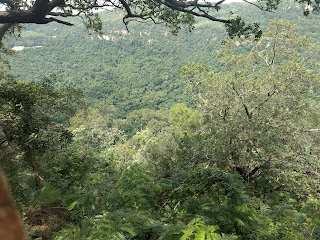 |
As we nearly reached the top,
the view below was breathtaking |
We had booked online the time for darshan. (Darshan is when one is at the sanctum sanctorum in front of the deity to offer the prayers). The reporting time was scheduled for 4 pm. But we ended up there at 3.30. Footwear and mobiles have to be deposited at a counter. They are securely kept in a barcoded container. The photo of the person who deposits the items is captured, which is then matched when the person goes to collect them from the counter near the temple complex exit.
 |
At a distance, beyond the open ground is the actual temple complex.
The photo was taken while we were exiting the premises. |
Before joining the long queue to the temple sanctum sanctorum, we had our credentials matched with what was entered when I booked the darshan timing online. We joined the queue around 3.45 pm. The line moved slowly. There are benches along the way for those who feel too tired to sit. We had our darshan at around 5.30 pm. The wait was not comparatively too long. One reason could be it's Diwali festival season, and many would prefer to be at home with relatives and friends.
Around 7.30 pm we were back. We came down by road. We had dinner at Orion Restaurant and hit the bed by around 10 pm after quite a tiring day.
October 29
While the three of us who came from Bhopal left by train around 9.30; we three returned to Bengaluru by bus. We were back home in the evening.
It was a good, enjoyable outing, which was a family reunion, a good trek, and spiritual getaway, all combined into one.


